
In this blog we explore the new Government Commercial Agency supply staff framework and how it aims to rebalance the market, saving schools money.
Schools across England spend approximately £1.4 billion a year on agency supply staff. Whilst many supply agencies operate well and have good relationships with schools, some have shown exploitative behaviours and focused on profit maximisation over value to schools and, ultimately, pupils.
The Department for Education (DfE) has negotiated a new deal within the Government Commercial Agency (GCA, formerly Crown Commercial Service) framework to cut costs and prioritise quality outcomes.
Why a new deal is needed
With 80% of school budgets spent on permanent staff, supply costs represent around 3% of total expenditure — but inflated agency fees mean that money too often fails to reach the classroom.
The new RM6376 Supply Teachers and Education Recruitment (STeER) framework agreement, launched in May 2026, has been specifically negotiated by the DfE to cap fees, address unacceptable practices and deliver frontline savings.
Crucially, the new framework introduces a cap on the supplier fees - not on what supply workers are paid. Agency staff pay and conditions are entirely unaffected. The cap targets agency mark-up, rebalancing the market in favour of schools without undermining the workforce they depend on.
Costs to schools are not always broken down transparently - with schools usually receiving a bulk daily charge or consolidated monthly invoice. An example daily charge can be broken down as:
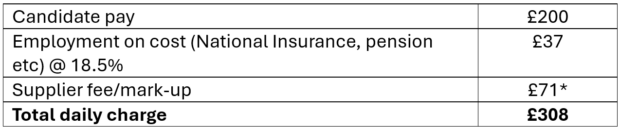
* This is a real example of the supplier fee/mark up charged to a school
The supplier fee is not 100% profit, it incorporates the operating costs to an agency such as the time and effort to source candidates, payments for all necessary background checks that are required to work in a school, etc.
What's new about the Supply Teachers and Education Recruitment framework?
The standout change is the introduction of maximum daily supplier fee rates across all role categories. These caps, which apply to agency mark-up only, are:
- STEM teachers: up to £45/day
- Non-STEM teachers: up to £40/day
- Educational Support Staff (non-SEND): up to £36/day
- Educational Support Staff (SEND): up to £38/day
- Senior roles (headteacher/SLT): up to £55/day
- Facilities management: up to £36/day
- Admin and clerical: up to £32/day
- Other roles: up to £34/day
Using the above example, of a supplier fee charged at £71 per day, per candidate, under the new capped rates the school in question would save a minimum of £26 per day, per candidate.
Additionally, the caps are maximum rates - many of the specialist education agencies who will be awarded places on the framework agreement have submitted lower rates. Schools are encouraged to check actual submitted rates via the GCA website once the framework goes live.
The framework has also been developed in collaboration with three other public sector buying organisations - Eastern Shires Purchasing Organisation (ESPO), North Eastern Purchasing Organisation (NEPO) and Yorkshire Purchasing Organisation (YPO) - giving it broader reach and stronger negotiating weight.
Alongside the rate caps, it includes a 12-week free temporary-to-permanent provision, meaning schools can take on supply staff permanently after 12 weeks without paying a transfer fee - a significant financial benefit that many current agency contracts do not offer. The waiving of these fees has recently saved a school approximately £150k over an 18-month period.
What this means for academy trusts from September
When the Academy Trust Handbook (ATH) is published in September 2026, it will include a clear requirement that trusts must use the GCA RM6376 framework for their supply staffing needs unless they have an alternative compliant arrangement with rates that do not exceed those available through the framework.
Trusts choosing not to use the framework will need to satisfy two tests:
- Any alternative arrangement must be compliant with the Procurement Act 2023 (PA23), with spend assessed at trust level — that is, aggregated across all schools within the trust, not individual schools. Trusts spending above PA23 financial thresholds must demonstrate they have conducted a compliant procurement process.
- The rates secured must not exceed the GCA framework rates.
For more information read our guidance on the supply staff mandate.
Trusts should also be alert to pressure from agencies to sign agency-specific terms and conditions rather than the official GCA call-off terms. Doing so risks voiding the contractual protections the framework provides, including the rate caps, the 12-week free-to-permanent provision, and safeguarding and audit standards.
Trusts with existing contracted arrangements will not be forced to exit them early but are advised to review their current rates against framework rates ahead of renewal.
If you want to learn more about the new supply staff framework you can email our supply staff team.
The bigger picture
This framework is just one initiative in DfE's wider Maximising Value for Pupils programme, which aims to help schools and trusts maximise value from every pound in four key areas: commercial spend; assets, including reserves; workforce deployment; and developing capabilities, including digital and technology.
Building on existing DfE tools and services, the programme offers expanded support through benchmark data, commercial deals, capability building and technology investment. DfE will also identify and address the systemic issues that prevent schools and trusts from getting the most from their budgets.
Leave a comment